
New Lenox, IL · Garage Door Service
What New Lenox Homeowners Should Know Before Calling Anyone
A look at what New Lenox's 1955-2004 housing stock and cold winters mean for garage door springs, panels, and openers, from New Lenox Garage Door Pros.
- Repairs & new doors
- Springs & openers
- Serving 6 nearby communities
What to Look At First
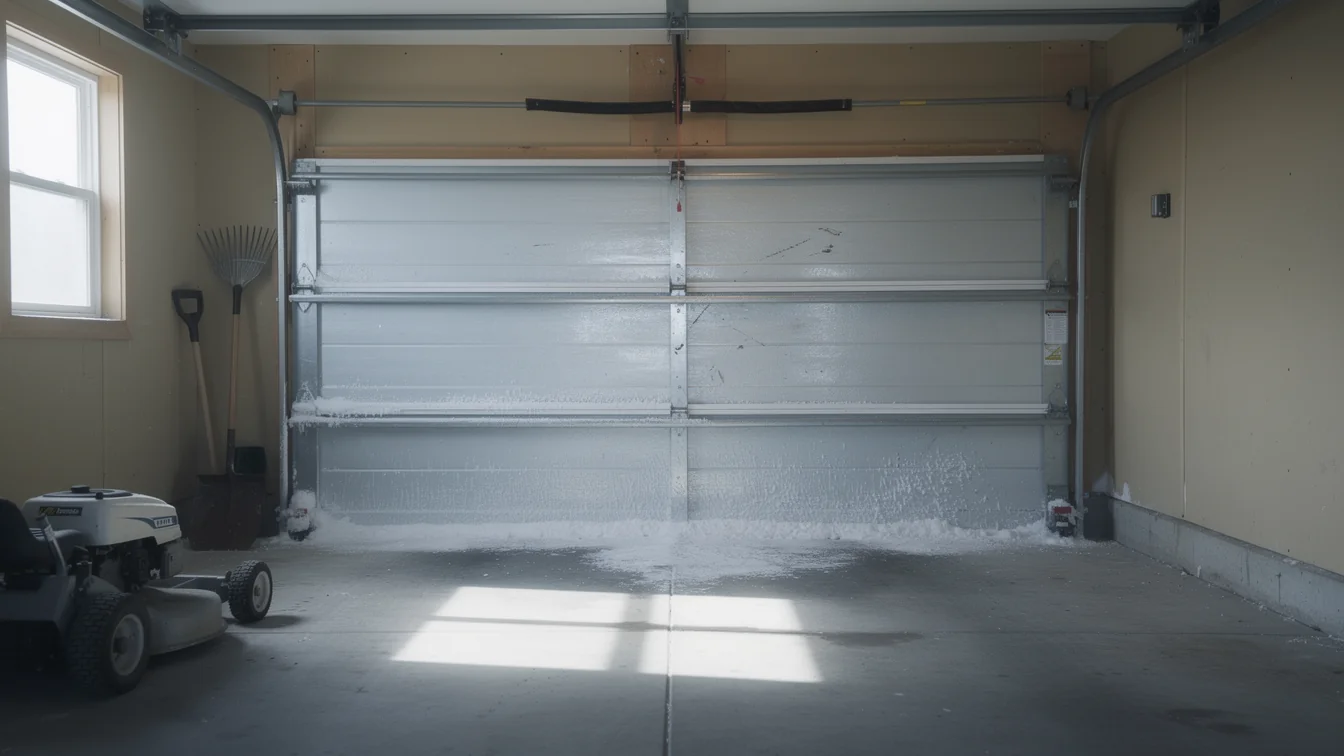
Start with the build year of your house, not the door. Most homes in this area went up between 1955 and 2004, with the median landing around 1976, which means the garage door hardware underneath that fresh paint is often original or close to it. Pop the garage light on and look at the spring over the header. If it's a single thick coil running the width of the door, you've likely got an older torsion setup sized for a lighter, uninsulated steel or wood panel - not the double-layer doors sold today.
Check the panels themselves for a foam core versus a hollow steel face. Builders working through the 1960s and 70s rarely specced insulation into a garage door; it wasn't code and it wasn't expected. If your panels feel light when you lift a disconnected door by hand, that's a single-layer skin, and it tells you a lot about what's been holding back heat loss (not much) for the last several decades.
Last, look at the track mounting. Older homes in this stretch sometimes used angle-iron brackets bolted straight to framing that's shifted a little over fifty-plus years. A track that's pulled even an eighth of an inch out of plumb will bind a roller long before a spring ever fails.
The Problem
The core issue is a mismatch between what these doors were built for and what they're being asked to do now. A door designed in 1976 for a single-car opener and a light steel panel is often still in service, but the opener bolted to it may be a second or third replacement from the 1990s or 2000s - newer than the door, and pulling against spring tension that was never recalibrated when the panel or opener changed.
That mismatch shows up as openers straining on cold starts, cables fraying at the drum because the spring is carrying more or less than the panel weighs, and rollers wearing unevenly in track that's flexed out of true over decades of settling. None of this is dramatic until it is: a snapped torsion spring on a door like this isn't a slow failure, it's immediate, and it usually happens on the coldest morning of the week because that's when steel is least forgiving.
We'll say the honest part here: not every door from this era is worth saving. Once a wood-core panel from the 1970s has delaminated at the bottom rail, patching it is a short-term fix, and replacement is the straighter path.
How Local Conditions Play In
This area sits in a cold, moderate climate band, which means real freeze-thaw cycling through the winter rather than one hard freeze that sets in and stays. That cycling is harder on garage door hardware than steady cold. Torsion springs lose a measurable amount of tension as temperatures drop, and a spring that's already borderline for an aging panel can go from 'a little sluggish' to 'snapped' across one cold front.
Weatherstripping on doors from the 1976-median housing stock was rarely a priority item when it was installed, and it degrades faster under repeated freeze-thaw than under constant cold. That's where the draft under the bottom panel usually comes from - not a gap that opened overnight, but seals that have hardened and cracked over years of the same cycle repeating.
Opener motors feel it too. A chain-drive opener working against a spring that's lost tension in the cold pulls harder on every start, and that extra load is what shortens gear and sprocket life on units that are already older than the home's most recent remodel. None of this is unique to any one house - it's a function of what this region's winters do to hardware that's been in place since before double-layer insulated panels were standard.
What It Costs
We don't have a flat number to give you here, and we're not going to invent one. What we can tell you is what moves the price up or down on a job like this. Spring size matters - a door sized for the heavier insulated panels common in newer construction needs a stronger torsion spring than the originals in older homes, and that's a parts cost difference, not a labor one. Panel replacement versus full door replacement is the other big fork: if the track, opener, and springs are sound, swapping just the panels costs less than starting over.
Across this service area, median household income runs a little over $78,000 and most houses are owner-occupied, which tends to mean homeowners who'll pay for a correct repair once rather than a cheap patch twice - that's worth knowing when you're deciding between a spring replacement and a full door swap. With roughly 154,000 owner-occupied houses in the broader area, a lot of them built in the same two-decade stretch, you're not an outlier for needing this kind of work; you're the typical case.
Get a specific number by having someone look at your actual spring size, panel condition, and track alignment in person. Anything quoted before that is a guess.
Frequently asked questions
My house was built in the 1970s - does that mean my garage door is original?
Not always, but it's common. A lot of homes from that era in this area still have the original torsion spring and track even if the panel or opener has been swapped once or twice since. Check the spring gauge and the track brackets - if they look original, treat the hardware as fifty years old even if the door face looks newer.
Why does my opener strain more in the winter?
Cold steel loses tension. In a cold, moderate climate with real freeze-thaw cycling, a torsion spring that's already carrying a heavier or older panel loses more of its lift on a cold morning, and the opener motor has to make up the difference. That extra load is what wears out gears and sprockets early.
Is it worth insulating an old single-layer panel instead of replacing the door?
Sometimes, if the track, springs, and opener are all sound and the panel itself isn't delaminated or rusted through. If the panel is a wood-core type from the 1960s-70s that's starting to separate at the bottom rail, insulating it is a short-term patch, not a fix.
Related garage door services in New Lenox
More garage door guides
Book garage door service in New Lenox
Call now or request a quote - tell us what the door is doing and where you are.