
New Lenox, IL · Garage Door Service
Garage Door Repair in New Lenox, IL
Most New Lenox garages date to the 1970s-80s building boom, and cold winters wear out torsion springs fast. We repair springs, cables, tracks, and openers.
- Repairs & new doors
- Springs & openers
- Serving 6 nearby communities
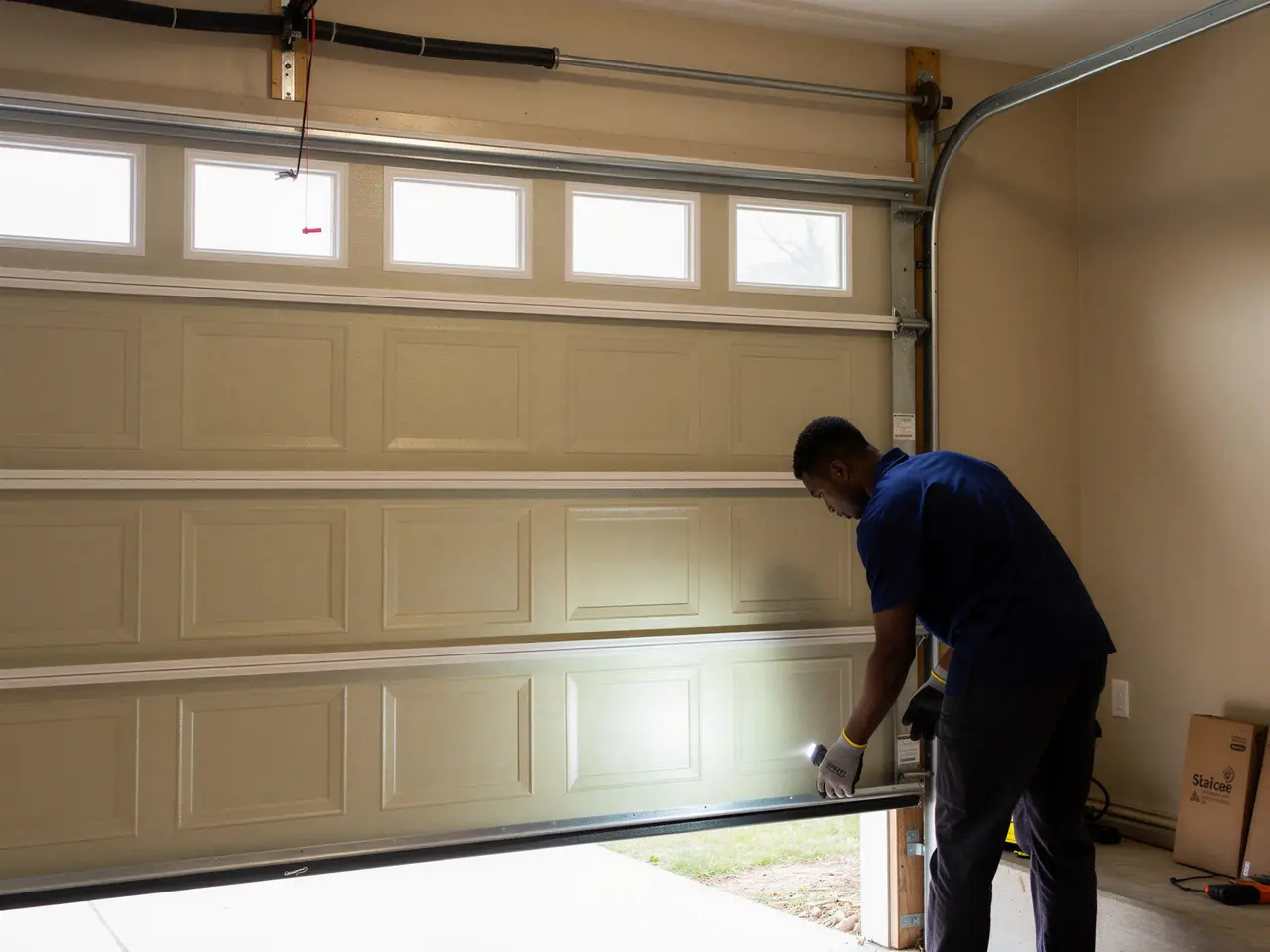
Can You Do This Yourself
A torsion spring holds enough stored force to break a hand or worse if it lets go while you're working on it, so that part of the job isn't a weekend project no matter how many videos you've watched. Swapping a roller, tightening a loose track bracket, or lubricating hinges - those are fair game for a homeowner with basic tools and some patience. Cables, springs, and anything inside the torsion tube are a different category of risk, and we'd rather tell you that up front than sell you a service call you didn't need.
What you can safely check yourself: whether the door is binding on one side, whether the opener's travel limits need adjusting, or whether a sensor is just dirty or knocked out of alignment. Those are five-minute fixes. What you shouldn't touch: a spring that's visibly unwound or snapped, a cable that's frayed near the drum, or a door that's come off its track entirely. If you're not sure which category you're looking at, don't force the door open or closed - that's usually how a bent track becomes a bent track plus a cracked panel. One honest limitation: if the bottom panel is cracked or rusted through along with hardware failure, we'll tell you replacement makes more sense than another round of patch repairs.
How Long It Takes
A straightforward torsion spring replacement or cable swap is usually done within an hour once the tech is on site and has the right spring size in the truck - double doors run a bit longer since there are two springs to balance against each other. Opener repairs or replacements take longer, mostly because of mounting, wiring to the wall control, and setting the travel limits correctly rather than the part itself.
What stretches a job past that window is almost always something that wasn't visible until the door came apart: a bent track hidden behind a panel, a stripped gear inside an older opener housing, or hardware that's been painted over and has to be worked loose carefully instead of just unbolted. Track realignment on its own is usually quick, but if a roller has been grinding against a bent section for months, the track itself may need replacing rather than reshaping.
We don't give you a number over the phone before we've seen the door, because a job that looks like a simple spring job sometimes turns out to be a spring plus a cable plus a drum that's worn a groove in the wrong spot. We'd rather quote it accurately in person than guess low and surprise you at the end.
What You Are Seeing
The most common call is a door that won't move at all - the opener hums or clicks but nothing happens, which usually means a broken torsion spring is leaving the opener to lift the full weight of the door alone, something it was never built to do. A loud bang from the garage, often in the early morning when the temperature has dropped overnight, is almost always that same spring letting go.
Other calls: a door that lurches and jerks instead of gliding, which points to a bent track or a roller that's worn down to the pin; a cable that's visibly frayed near the bottom bracket, which needs replacing before it snaps rather than after; or a door that reverses itself halfway down, which is usually the safety sensors being knocked out of alignment or blocked rather than a hardware failure. If the door opens fine but sags or tilts to one side when it's down, that's often one spring doing more work than the other after one of a pair has weakened.
We also see openers that run but don't engage the chain or belt - a worn drive gear inside the unit, common once an opener's been in service long enough that the housing plastic itself is original to the house.
What Causes It Around Here
New Lenox's housing stock runs mostly 1955 through 2004, with the bulk of it built through the 1960s and 70s and a median build year around 1976. That matters for garage doors specifically because torsion spring hardware from that era was rated for a certain number of open-close cycles, and a lot of these houses are decades past that number with the original spring still hanging in the torsion tube. Nobody replaced it because nothing visibly broke - until the day it does, usually without warning.
The cold climate here adds to that wear. Steel springs and tracks contract in cold weather, which changes the tension on a spring that's already near the end of its rated life and makes a marginal spring more likely to snap on a cold morning than a mild one. Track alignment suffers too - a slightly bent track that was fine in summer can bind hard once the metal contracts.
Across the broader area we work in, with 280,808 households and 153,879 owner-occupied houses, a good share of that housing shares this same age profile, which is why spring failure and worn roller/track combinations are the calls we see most, rather than anything exotic.
Frequently asked questions
Why did my garage door spring break on a cold morning?
Steel contracts in cold weather, which adds tension to a spring that's already near the end of its rated cycle life. Combined with New Lenox's older housing stock - much of it built in the 1960s and 70s - a lot of original torsion springs are overdue for replacement, and a cold snap is often what finally breaks one.
Can I replace a torsion spring myself?
We don't recommend it. A torsion spring holds enough stored force to cause serious injury if it releases while you're working on it. Smaller jobs like roller replacement or track lubrication are reasonable for a homeowner to handle; springs and cables are not.
My door opens but sags on one side - what's wrong?
On a two-spring system, this usually means one spring has weakened while the other is still holding closer to full tension, so the door tilts toward the weaker side. It's worth having both springs checked and typically replaced as a pair, since the second one is usually close behind.
Is it worth repairing an old opener or should I replace it?
Depends on what's failed. A worn drive gear or a bad circuit board on an older unit is often cheaper to replace outright than to repair piece by piece, especially once the housing itself is original to a decades-old install. We'll tell you honestly which way the math points once we've looked at it.
Book garage door service in New Lenox
Call now or request a quote - tell us what the door is doing and where you are.