
New Lenox, IL · Garage Door Service
Knowing When Repair Stops Making Sense in New Lenox
New Lenox homes mostly date to the 1960s-70s building boom, median year 1976. Here's how to tell if your door is worth fixing or past it, given that age.
- Repairs & new doors
- Springs & openers
- Serving 6 nearby communities
What to Look At First
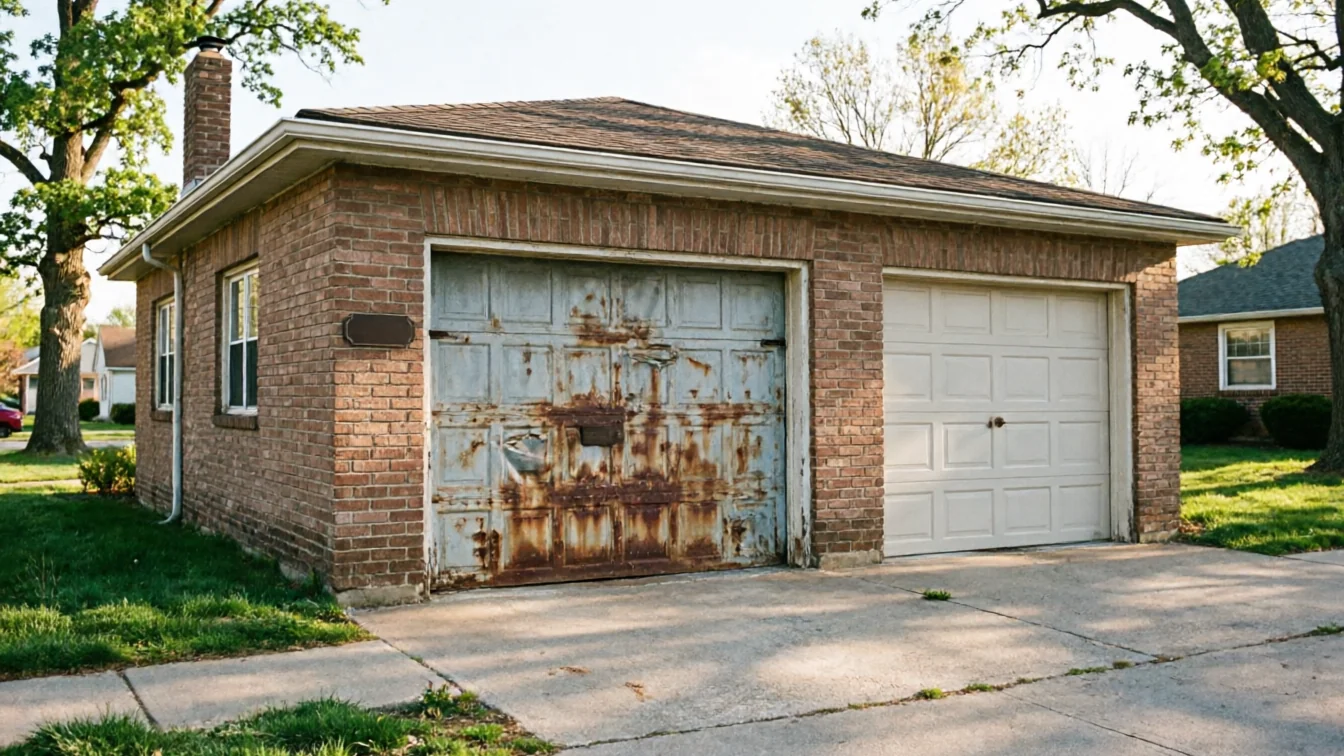
Start outside, at the panels. A lot of New Lenox housing went up between 1955 and 2004, with the median build year sitting around 1976 - so a big share of doors on this side of town are original or close to it, pushing fifty years old. Look for rust blooming at the bottom panel seam, hinges with play in them, and a track that's bowed rather than straight. If the door is a steel sectional from that 1960s-70s wave, check whether the panels still sit flush when closed; warping there usually means the door has taken on moisture for years.
Next, the spring. Torsion springs have a rated cycle life, and a door installed when your house was built has likely burned through more than one spring already, sometimes without you knowing it was swapped. If you can see a gap in the coil or hear a bang when the door closes, that's your spring, not your opener.
Last, the opener chain or belt. Openers from the original build era are long gone in most houses, but if yours is more than fifteen years old and grinding on the open cycle, that's wear in the gear, not something a tune-up fixes. None of this tells you repair-or-replace on its own - it tells you what to bring to the call.
The Problem
The core issue with housing stock from the 1955-2004 window, median 1976, is that the doors and hardware were built to specs nobody stocks anymore. A door panel from that era often doesn't match current standard widths or the gauge of steel used today, so a cracked panel can mean the whole door gets replaced even when the rest of it is fine. Same with older torsion hardware sized for a door that's heavier or lighter than current models - the parts exist, but tracking them down takes longer than most homeowners expect.
This is also where repair stops being the economical choice. If you're replacing a spring, a cable, and resetting a track that's bent from age, you're most of the way to the cost of a new door section by section. A door built in the 1960s or 70s has usually had multiple small repairs layered on top of each other by the time a homeowner calls. At some point the labor on patch repairs costs more than starting clean, and that point comes sooner on a door this old than on one from the last ten years.
How Local Conditions Play In
New Lenox sits in a cold, moderate climate band - not extreme, but enough swing between summer and winter that steel panels expand and contract every season. On an older door without foam-filled panels, that cycling works seals loose over time, especially the bottom weatherstrip, which is usually the first thing to fail and let drafts into the garage.
Temperature swing also matters for springs. Cold snaps make torsion springs stiffer and more likely to snap on a cold morning if they're already near the end of their cycle life, which lines up with a lot of the original hardware in homes from the 1960s and 70s. If your door has started sticking or binding specifically in winter and running fine in summer, that's the steel and the spring tension reacting to temperature, not a coincidence.
This is also the honest limitation: a tune-up can rebalance a door for the season, but it won't fix hardware that's simply worn out. If the spring's near its end, cold weather will find that out for you, usually at the worst time.
What It Costs
We don't have a flat number to put here, because what a door needs after fifty years varies too much to quote without seeing it - a spring swap is a different job than replacing panels and track on a door that's been patched twice already. What we can tell you is how to think about the split.
If your house falls in that 1955-2004 build range, especially near the 1976 median, and the door is still original, replacement parts for springs and hardware are getting harder to source exactly matched, which pushes repair cost up relative to a new door. If the opener and track are newer than the door itself - common in houses where a previous owner replaced the opener but not the door - repair usually still makes sense.
Income and household data for the area (median household income around $78,132 across roughly 153,879 owner-occupied houses) tell us this is a market where people maintain rather than let things go, which is part of why we'd rather give you a straight answer on repair versus replace than sell a repair that won't hold. Have us look at the door in person before you decide either way.
Frequently asked questions
My garage door is original to the house - is it worth fixing?
Depends what's wrong. If it's a spring or cable on an otherwise straight, flush door, repair usually makes sense even on an original door from the 1960s-70s building era. If panels are warped or rusted through, you're often better putting that money toward a new door instead of chasing parts for an old one.
Why did my door get harder to open this winter?
Cold makes torsion springs stiffer and steel panels contract slightly, which is more noticeable on older doors without foam insulation. If it's binding only in cold weather, that's the spring and hardware reacting to temperature, not necessarily a new problem - but it's worth having checked before the spring fails outright.
How do I know if it's the opener or the door itself?
Pull the manual release and try lifting the door by hand. If it's heavy or uneven, that's spring or hardware, not the opener. If it lifts smoothly but the opener won't run it, the problem's electrical or in the opener's gear, which is usually the cheaper fix of the two.
Related garage door services in New Lenox
More garage door guides
Book garage door service in New Lenox
Call now or request a quote - tell us what the door is doing and where you are.