
New Lenox, IL · Garage Door Service
Is Your New Lenox Garage Door Worth Repairing, or Time to Replace?
New Lenox homes mostly date 1955-2004, median 1976. Here's how that building era and our cold-moderate climate decide whether your garage door is worth repairing or replacing.
- Repairs & new doors
- Springs & openers
- Serving 6 nearby communities
What to Look At First
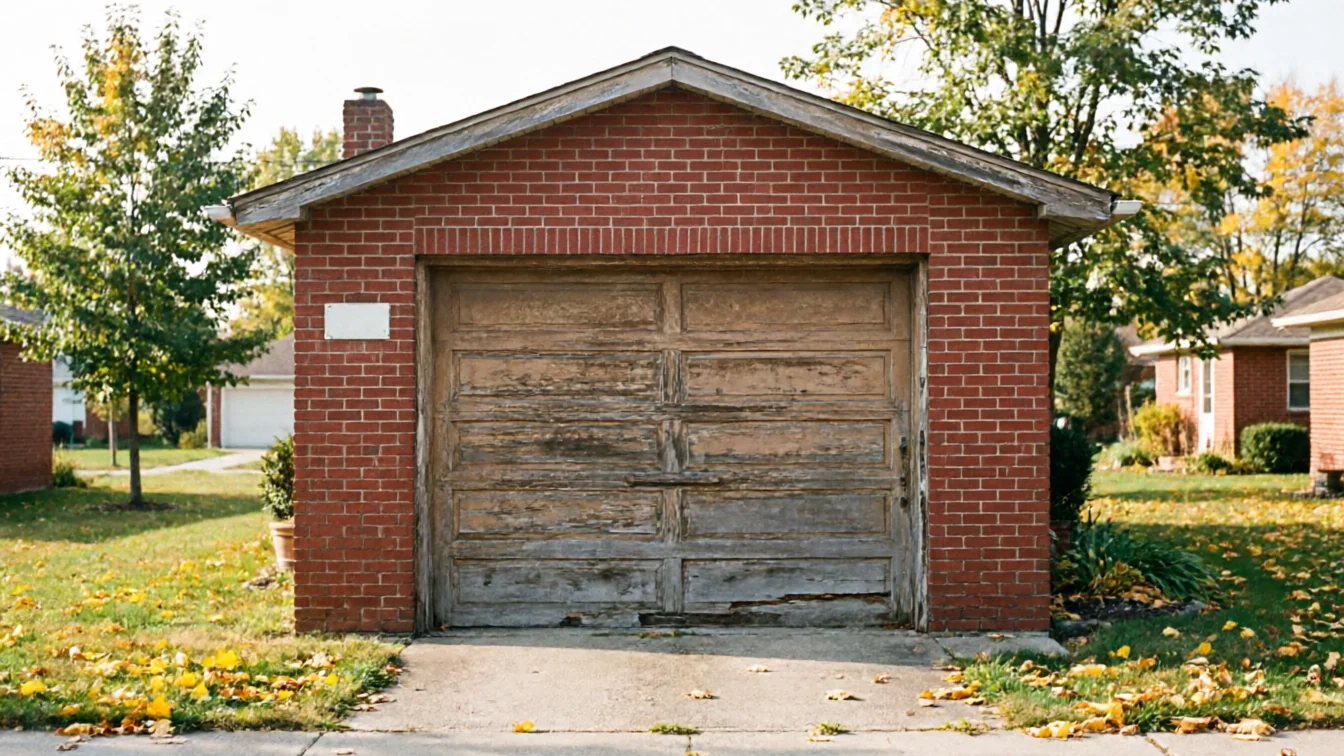
Before you call anyone, walk out to the garage and look at the door itself, not just whether it opens. Most houses in New Lenox and the towns around it went up between 1955 and 2004, with the median landing around 1976. That means a lot of doors out there are either the original installed when the house was framed, or the first replacement someone put in sometime in the 80s or 90s. Neither one was built with today's insulation standards or today's spring hardware.\n\nCheck the panels for rust bubbling through the paint, especially along the bottom seam where water sits. Check whether the door has one torsion spring across the top or two - single-spring setups were common on older single-car doors and they're harder to find parts for now. Look at the track mounting: older homes often have the horizontal track bolted straight into wood jambs that have shifted over fifty-some years, which throws the whole door out of square even if the panels look fine. Age alone doesn't condemn a door. What it fixed to, and how it's held up, does.
The Problem
The core issue with a door built anywhere near that 1976 median is that it's now pushing fifty years old, and garage door hardware wasn't made to last that long without attention. Torsion springs have a rated cycle life, and a door that's opened twice a day for five decades has gone through more cycles than the spring was designed for, even if nobody ever changed it. When one of those springs lets go on an old door, you often find the drum, the cable, and the end bearing plate are all original parts in sizes nobody stocks anymore, because the manufacturer that made that exact system may not even be in business.\n\nPanels are the other half of the problem. A steel door from the 60s or 70s is usually a single layer of thin steel with no foam core, so it's dented easier and it telegraphs every bump straight through. Wood doors from that era, especially ones that haven't been repainted in years, are often rotting from the bottom rail up. Replacing one bad panel on a 1970s door frequently means the whole section is discontinued, and the only option left is a full door.
How Local Conditions Play In
New Lenox sits in a cold, moderate climate band, which means real winters with hard freeze-thaw cycles rather than one-off cold snaps. That matters a lot for a door that's already decades old. Steel contracts in the cold, and a torsion spring under constant tension loses some of its give over fifty winters of that cycle, which is part of why old springs tend to snap on the first genuinely cold morning of the season rather than in July.\n\nMoisture is the other factor. Freeze-thaw cycling pushes water into any seam where paint has worn through on an older steel door, and that's usually at the bottom panel and around the weatherstrip track. On a newer door with a galvanized coating and a proper vinyl seal, that's not much of an issue. On a door old enough to have outlived its original finish, it's often the reason the bottom panel is the first thing to go. None of this means an old door is doomed, but it does mean a door that's marginal in a warmer, drier climate is often not marginal here - it's actively failing.
What It Costs
I can't give you a number without seeing the door, and I'd rather say that plainly than guess. What I can tell you is how the decision usually breaks down. If the problem is a broken spring, worn rollers, or a misaligned track on a door that's otherwise solid, repair almost always makes sense regardless of the door's age - that hardware is standard even on an old frame. If the damage is to the panels themselves, or the opener and the springs and the track are all original and all failing around the same time, you're often repairing the same door three times in two years, and that adds up faster than most people expect.\n\nOne honest limitation: parts for some older single-spring systems and certain discontinued panel profiles have long lead times, sometimes longer than a homeowner wants to wait with a garage that won't close. In those cases I'll tell you straight that replacement is the faster and often cheaper path, even if the door itself still has some life left in the frame. With a median household income of $78,132 across this area, most people here want a clear answer, not a maybe.
Frequently asked questions
My garage door is from the 1970s. Is it even worth fixing?
It depends what's actually wrong. A snapped spring or worn rollers on an otherwise square, solid door is almost always worth fixing no matter its age - that hardware is standard. If the panels are rusted through or the door has been repaired three times already, you're usually better putting that money toward a new door instead.
Why did my spring break in the middle of winter?
Steel loses some flexibility in sustained cold, and a torsion spring that's already near the end of its cycle life is more likely to fail on a hard freeze than in warmer months. If your door and springs are original to a house built decades ago, winter is when age usually catches up with it.
Can you still get parts for an older garage door?
For standard hardware like springs, cables, and rollers, yes - those are sized to fit most tracks regardless of the door's age. For discontinued panel profiles or certain older single-spring assemblies, parts can be harder to source and sometimes take longer to get, which is worth knowing before you commit to a repair.
Related garage door services in New Lenox
More garage door guides
Book garage door service in New Lenox
Call now or request a quote - tell us what the door is doing and where you are.