
New Lenox, IL · Garage Door Service
What Wind Does to a Wide Garage Door in New Lenox
New Lenox homes mostly date to 1960-70s construction with wide double doors. Here's what wind does to them and what it actually costs to fix or brace.
- Repairs & new doors
- Springs & openers
- Serving 6 nearby communities
What to Look At First
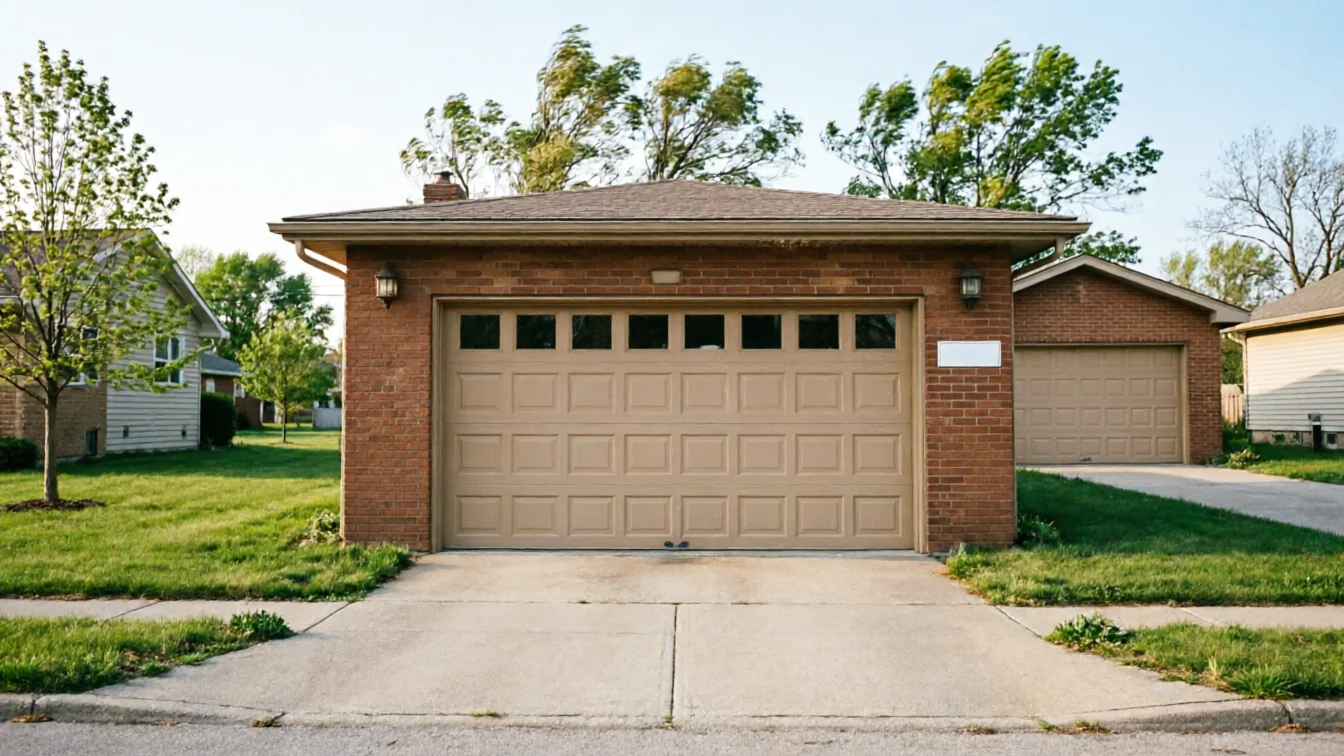
Start with the door itself, not the opener. A huge share of New Lenox houses went up between 1955 and 2004, with the thick of that building happening in the 1960s and 70s. That era favored wide, single-panel double doors on the garage front, often without any horizontal strut running across the back of the panels. If your house falls into that window, walk out and look at the top panel in a stiff gust. If you see it bow or flex visibly, that's not cosmetic - that's a panel with no internal bracing taking the full push of the wind across its whole width.
Check the track brackets next, especially where the vertical track bolts into the wood jamb. On houses from that build period, those brackets were often fastened with wood screws into framing that's now 50-plus years old. Loose brackets plus a wide door plus wind load is the combination that ends with a track pulled off the wall. Also look at the hinges between panels - if a double-wide door is original to a 1960s or 70s build, those hinges have taken decades of flex cycles even before wind gets added to the mix.
The Problem
A wide double door - the kind common across New Lenox's 1960s and 70s housing stock - has roughly twice the surface area of a single-car door, which means roughly twice the wind load pushing or pulling on it during a gust. Without internal reinforcement, that load doesn't stay at the edges. It travels into the center of the panel, where the door is weakest, and it travels into the track brackets, which were sized for a door sitting still, not one flexing in and out.
Most reinforcement standards for wind load came after the bulk of this area's housing was built - the median build year here sits around 1976 - so doors original to those homes typically have no strut bracing at all. That's not a flaw in the door; it's just a door built for a different set of expectations. The failure mode is predictable: a panel cracks along a seam, a track bracket pulls loose from the jamb, or in the worst case the whole door comes off its tracks during a sustained gust. None of that requires a storm - a steady spring wind across an open double door is enough.
How Local Conditions Play In
New Lenox sits in a cold, moderate climate band, which means the wind problem doesn't show up in isolation - it shows up alongside freeze-thaw cycling. Cold tightens steel track and stiffens nylon rollers, so a door that already flexes under wind load has less give in its hardware to absorb that flex. A track bracket that's marginal in July can be the one that lets go in a January gust, because the metal and the wood jamb behind it have both contracted.
This matters more on original hardware than on anything replaced in the last couple decades, since older doors on 1960s and 70s-built garages were never speced for sustained wind combined with repeated freeze cycles. If your rollers are original and your door is original to a house from that build era, the hardware has been through roughly five decades of that cycle. That's a long time for a bracket to stay tight on its own.
What It Costs
I can't give you a number without seeing the door - a loose bracket on sound hardware is a short visit, while a cracked panel on an original 1960s or 70s door often means the door is past the point where patching makes sense, since matching panels for a door that old usually isn't realistic. What drives the cost is less the wind damage itself and more what it reveals: whether the track brackets are still anchored into solid wood, whether the panels have internal struts or none, and whether the springs were sized for a door that's been flexing for years instead of sitting flat.
Strut reinforcement on an unbraced double door is usually the cheaper fix if the panels themselves are sound. Full replacement becomes the better call once a panel has cracked or the door has come off track more than once - at that point you're paying to keep patching a door that was never built with wind bracing to begin with, and the parts to retrofit it properly often cost more than starting fresh.
Frequently asked questions
Why does my wide garage door flex more than my neighbor's single door?
Surface area. A double-wide door catches close to twice the wind load of a single-car door, and if it's original to a 1960s or 70s New Lenox build, it likely has no internal strut bracing to resist that push across the middle of the panel.
Is a bowing panel an emergency?
Not usually on its own, but it's a sign the panel has no reinforcement. Left alone through repeated wind, it can crack at a seam or put enough stress on the track brackets that they pull loose from the jamb. Worth addressing before the next storm, not during one.
Can you just add bracing to an old door instead of replacing it?
Sometimes - if the panels themselves are sound and the track brackets are still solidly anchored, a strut kit across the top panel can cut down the flex. Once a panel has cracked or hardware has failed repeatedly, bracing an old door stops being the economical choice.
Does cold weather make the wind problem worse?
Yes. New Lenox sits in a cold, moderate climate band, and cold tightens steel track and stiffens rollers. A bracket that holds fine in warm weather has less give in winter, so a gust that would just flex the door in summer can be the one that pulls a bracket loose in January.
Related garage door services in New Lenox
More garage door guides
Book garage door service in New Lenox
Call now or request a quote - tell us what the door is doing and where you are.