
New Lenox, IL · Garage Door Service
What a Technician Checks First on a New Lenox Garage Door
A New Lenox tech's first-look checklist, built around this town's 1955-2004 housing stock, cold-climate spring wear, and the hardware that era actually shipped with.
- Repairs & new doors
- Springs & openers
- Serving 6 nearby communities
What to Look At First
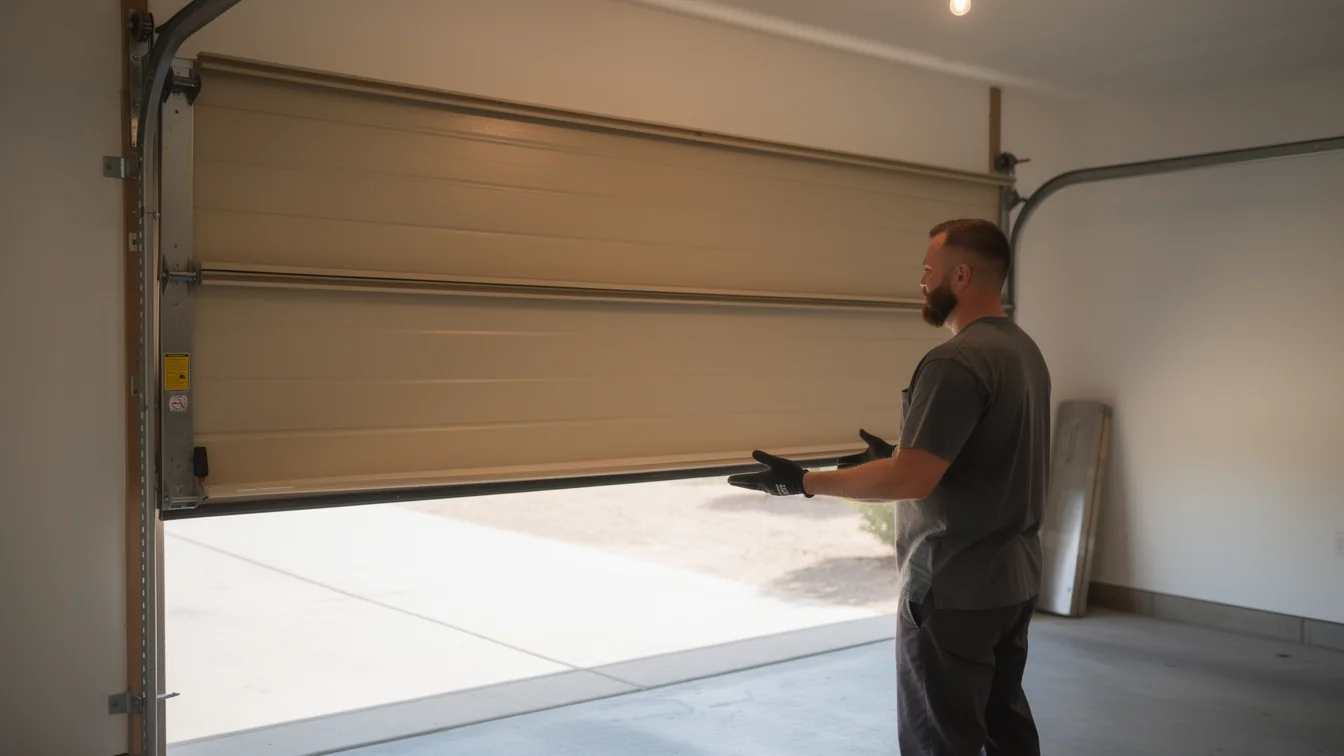
Before a tech touches a wrench, they're looking at the door itself - age, panel material, and what kind of spring system it's running. In New Lenox, that first look matters more than in a newer suburb, because the housing here went up between 1955 and 2004, with the median landing around 1976. A door built or replaced anywhere near that median is old enough that its torsion hardware is the original style - steel winding cones, stationary cable drums, and springs sized for a door that's heavier than most people think.
The second thing a tech checks is the track and roller alignment, because homes from the 1960s and 70s often have garages that have settled a little over fifty-plus years. That shows up as a track that's a half-inch out of plumb, which puts extra load on one side of the spring system and wears the rollers unevenly. A tech will run a hand along both tracks before ever touching the opener, because an opener problem that's actually a track problem burns a service call for nothing.
Last is the opener's safety sensors and the manual release. On a house this age, those sensors have often been swapped once already, sometimes incorrectly aimed. None of this is unique to any one street - it's what the housing stock here, specifically, tends to produce.
The Problem
Across the 61 named areas this region covers, the stock is mostly 1960s and 70s construction, and that's the root of most service calls here, not any single bad part. A garage door from that build era was almost always a torsion-spring system on a single steel track, sized to the door weight standards of the time - standards that have shifted since. When a homeowner adds a heavier insulated replacement door onto 50-year-old track and header hardware, the spring is now working harder than it was sized for, and it fails sooner than it should.
The other recurring issue is wiring and bracket corrosion where the original hardware was never upgraded. A lot of these garages still have the original header bracket holding the torsion rod, and after decades of seasonal temperature swings, the lag bolts work loose in the wood. It's not a dramatic failure - usually just a door that sags a quarter-inch on one side - but it's the kind of thing that gets missed until a spring finally lets go.
Honest limitation: if the header framing itself has pulled away from the structure, that's a carpentry fix before it's a garage door fix, and no amount of new hardware solves it on its own.
How Local Conditions Play In
This area sits in a cold, moderate climate band, and that matters for one part specifically: the torsion spring. Steel coils contract in cold weather, which tightens the spring and increases the force it exerts when the door opens. A spring that's already near the end of its life cycle - common on houses from the 1960s-70s stock that makes up most of this area - is far more likely to snap on a cold morning than in July, because the extra tension finds the weak point.
Temperature swings also affect the lubricant on rollers and hinges. Grease that's fine in summer stiffens up in winter, which is why a door that opened quietly in August starts grinding or hesitating once the cold sets in. A tech checks lubrication on every cold-season call for this reason, not as an upsell, but because it's often the actual fix.
Condensation is the other factor worth a look - unheated garages here go through real freeze-thaw cycles, and moisture working into wood jambs or steel brackets over enough winters is part of why original hardware from this era needs replacing well before the door panels themselves wear out.
What It Costs
We're not going to put a number here that doesn't hold up once a tech is standing in front of your actual door - the spread between a roller adjustment and a full torsion spring replacement with upgraded cable drums is wide, and guessing at it before an inspection does nobody any favors. What does affect cost, specifically in a house built in the 1955-2004 window common to this area, is whether the original hardware can be reused or has to be replaced outright.
A door with original header brackets and track from the 1960s or 70s often needs more than just a spring - once a tech is in there, worn rollers, a stretched cable, or a cracked drum tend to surface too, because that hardware has been running the same number of open-close cycles for decades. That adds labor and parts, but replacing everything at once also means you're not paying for a second service call in a year.
One honest limitation: certain spring sizes and drum types used on older torsion setups aren't something we keep on the truck - they may need to be ordered, which can add a day or two to a repair that would otherwise be same-day.
Frequently asked questions
Why does my garage door spring keep breaking in winter?
Steel contracts in cold weather, which tightens a torsion spring and increases the force it carries each time the door opens. If the spring is already older - common on houses from the 1960s-70s stock typical of this area - that extra tension is often what finally breaks it, rather than one dramatic failure out of nowhere.
Is my garage door hardware original to the house?
If your house was built anywhere near the 1976 median for this area, there's a real chance the torsion rod, header bracket, and track are original. A tech can tell quickly by looking at the winding cone style and bracket design - older hardware looks noticeably different from anything installed in the last fifteen years.
Do you repair or replace older torsion systems?
Both, depending on what a tech finds once the door is inspected. If the track and header hardware are sound, a spring and roller service is usually enough. If the bracket or track has worn out along with the spring, replacement of the whole system often makes more sense than repeated repairs.
Related garage door services in New Lenox
More garage door guides
Book garage door service in New Lenox
Call now or request a quote - tell us what the door is doing and where you are.