
New Lenox, IL · Garage Door Service
Spring Repair for Manhattan's Newer Housing Stock
Manhattan, IL has about 3,325 households and most homes went up around 2004 - newer torsion hardware, different failure points than older suburbs. We cover it from New Lenox.
- Repairs & new doors
- Springs & openers
- Serving 6 nearby communities
What Causes It Around Here
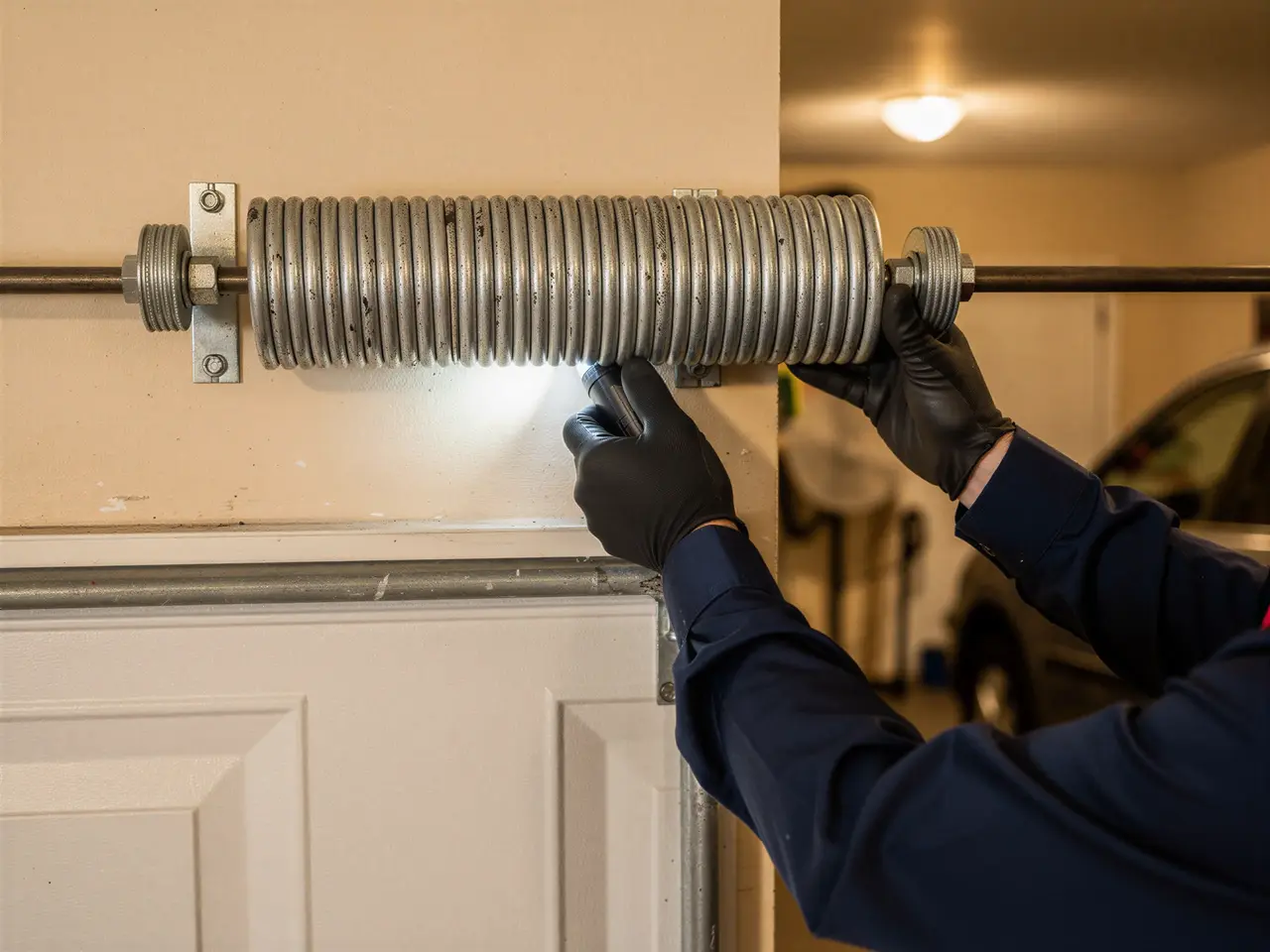
Manhattan is a small town - about 3,325 households - and most of what's out there went up around 2004, well past the median build year of 1976 that covers a lot of the wider service area. That matters for springs. A door built in the early 2000s is almost always on torsion hardware sized for an insulated steel door, not the older extension-spring setups you still find on homes from the 1970s a few towns over. The failure mode here is usually a torsion spring that's simply hit its cycle count - not a mismatched or undersized spring fighting a door it was never meant to lift. Winters here still sit in a cold, moderate climate band, and cold steel is more brittle steel. A spring that's been cycling fine for fifteen years can snap on the first hard freeze of the season. We also see broken center brackets and worn bearing plates on these newer torsion setups, since the hardware is lighter-gauge than what you'd find on an older heavy wood door. It's not a bad thing - it's just a different thing to diagnose.
Booking a Visit
We run out of New Lenox, about 6 miles up the road, so there's no local branch in Manhattan - just a truck that comes out on the call. When you reach out, tell us the door size (single or double) and whether it's lifting with one spring or two; most doors built in this era use torsion springs mounted on a shaft above the door, and knowing that up front saves time on the visit. If the door won't budge at all and you hear a loud bang before it happened, that's almost always the spring letting go - don't force the opener, it'll just burn out the motor trying to lift a door with no counterbalance.
Stocked Parts
We carry common torsion spring sizes on the truck, along with center brackets, bearing plates, and cables, since those are the parts that wear alongside a spring on a 2000s-era door. What we don't always have on hand is a spring custom-wound for an oversized or unusually heavy door - those get ordered to match the door's weight and drum size, and that can mean a short wait. If your door is a wide double built with a heavier insulated panel, we'll measure on site before promising same-visit install.
What You Are Seeing
A door that won't lift, or that lifts a few inches and stops, is a spring problem nine times out of ten on this kind of door. If you see a visible gap in the coil above the door - a clean break, not a slow sag - that's a torsion spring that's done. A door that feels heavy at the bottom of its travel but light at the top, or that slams down fast instead of lowering evenly, is usually a spring that's weakened but hasn't snapped yet. Don't keep running the opener through it; that's how you turn a spring job into a spring-and-opener job.
Where This Job Goes Sideways
The job gets harder when a homeowner tries to replace the spring themselves and gets the winding cone wrong, or when the door's been running on a weak spring long enough that the opener's drive gear is also chewed up. On the newer doors common in Manhattan, we also run into cases where the original builder used a non-standard shaft length or drum - not common, but it happens on production-built homes from the early 2000s, and it means the replacement spring has to be matched rather than grabbed off the shelf. One honest limit: if the door is also sagging or the tracks are bent, swapping the spring won't fix the underlying problem, and we'll tell you that instead of billing you twice.
Frequently asked questions
Why would a door built in 2004 need a different spring than an older one?
Doors from this era are almost always on torsion springs sized for insulated steel panels, not the extension-spring setups common on older homes nearby. The spring, drum, and shaft have to match the door's weight and width, so a spring that works on a 1970s door usually won't fit a 2000s-era one.
Do you have a shop in Manhattan?
No - we run out of New Lenox, about 6 miles away, and come to you. There's no local branch here, just a truck dispatched for the call.
How cold does it have to get before a spring snaps?
We're in a cold, moderate climate band here, and steel gets more brittle as temperatures drop. A spring near the end of its cycle life often lets go on the first hard freeze rather than during a mild stretch, even if it looked fine a week earlier.
Can I just replace the spring myself?
We don't recommend it. A torsion spring is under heavy tension and the winding cones are unforgiving if the size or wind direction is off. We stock common sizes on the truck and can usually match the hardware on the same visit.
More garage door services in Manhattan
Book garage door service in New Lenox
Call now or request a quote - tell us what the door is doing and where you are.